
- If you are wondering whether RLI is offering good value at its recent price, you are not alone. This article will walk through how the current share price stacks up against several valuation checks.
- RLI shares last closed at US$63.29, with returns of 3.6% over the past week, 8.3% over the past month, 1.3% year to date, a 12.6% decline over the past year, 2.7% over three years, and 37.1% over five years, which gives a mixed picture of recent and longer term performance.
- Recent headlines around RLI have been more focused on maintaining coverage and keeping investors informed, rather than on a single event that would clearly explain these price moves. That context makes it especially useful to step back and test the current share price against a range of valuation tools.
- On Simply Wall St's 6 point valuation check, RLI currently scores 0 out of 6. Next, we will compare what different valuation approaches say about the stock and finish with a broader way to think about valuation that many investors find even more useful.
RLI scores just 0/6 on our valuation checks. See what other red flags we found in the full valuation breakdown.
Approach 1: RLI Excess Returns Analysis
The Excess Returns model asks a simple question: are RLI’s future profits likely to exceed the return that shareholders require on their capital, and by how much? It builds value from the gap between return on equity and the cost of equity, rather than from cash flows.
For RLI, the model uses a book value of US$19.35 per share and a stable EPS of US$2.89 per share, based on weighted future return on equity estimates from 8 analysts. The average return on equity is 13.95%, compared with a cost of equity of US$1.44 per share. That difference produces an excess return of US$1.44 per share, which is then projected on a stable book value of US$20.70 per share, sourced from 7 analysts’ book value estimates.
Using these inputs, the Excess Returns model arrives at an intrinsic value of about US$61.12 per share, which is around a 3.6% premium to the recent share price of US$63.29. On this basis, RLI screens as slightly overvalued, but only by a small margin that many investors might consider within a normal valuation band.
Result: ABOUT RIGHT
RLI is fairly valued according to our Excess Returns, but this can change at a moment's notice. Track the value in your watchlist or portfolio and be alerted on when to act.

Approach 2: RLI Price vs Earnings
For a profitable company like RLI, the P/E ratio is a useful way to relate what you are paying per share to the earnings the business is currently generating. It gives you a quick sense of how many dollars investors are willing to pay today for each dollar of earnings.
A “normal” or “fair” P/E usually reflects what the market thinks about a company’s earnings growth potential and risk profile. Higher expected growth or lower perceived risk can justify a higher P/E, while lower growth or higher risk often line up with a lower P/E.
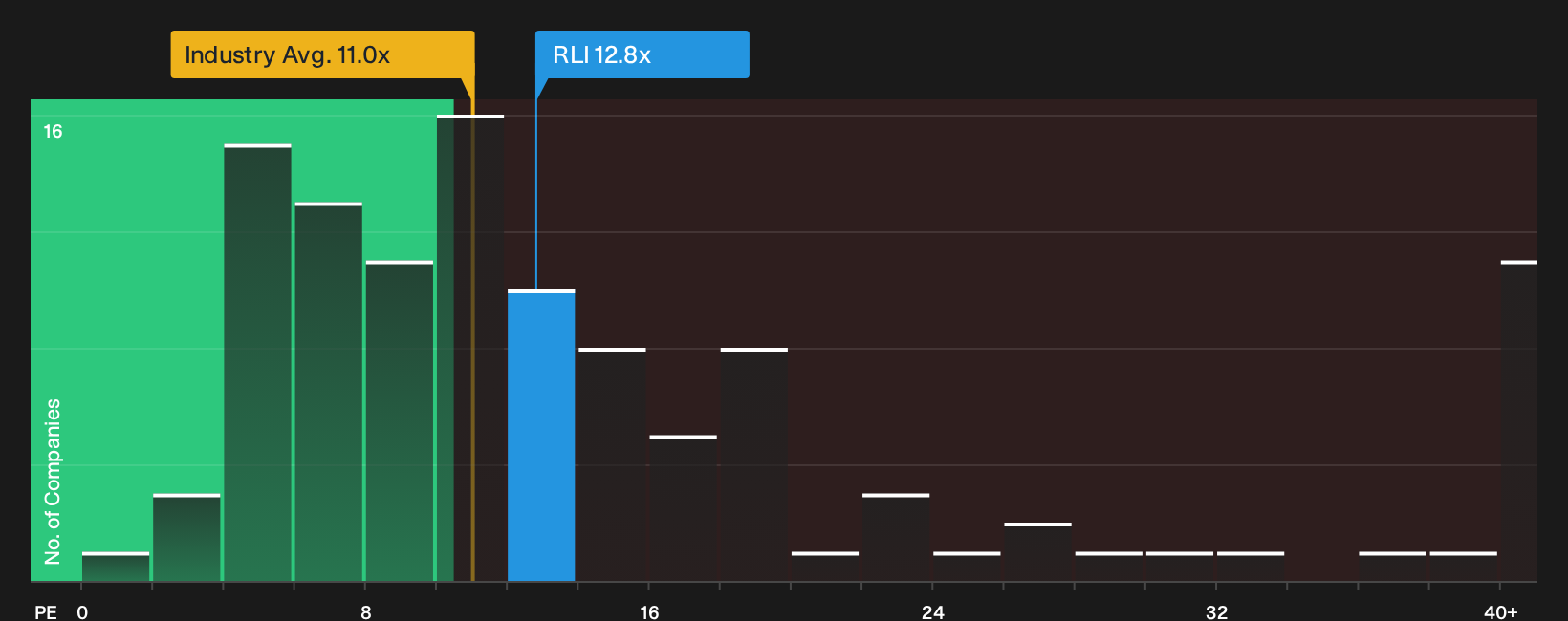
RLI currently trades on a P/E of 14.42x. That sits above both the Insurance industry average of 12.02x and the peer group average of 9.94x. Simply Wall St also calculates a Fair Ratio of 8.55x for RLI. This is a proprietary P/E estimate that incorporates company specific factors such as earnings growth characteristics, profit margins, risk, industry and market cap, so it can be more tailored than a simple comparison with peers or the broad industry.
Comparing RLI’s actual P/E of 14.42x with the Fair Ratio of 8.55x suggests the shares are trading above that model’s indication of fair value.
Result: OVERVALUED
P/E ratios tell one story, but what if the real opportunity lies elsewhere? Start investing in legacies, not executives. Discover our 18 top founder-led companies.
Upgrade Your Decision Making: Choose your RLI Narrative
Earlier we mentioned that there is an even better way to understand valuation. Narratives let you attach a clear story about RLI to the numbers you care about by linking your view of its future revenue, earnings and margins to a forecast and then to a fair value that you can compare with the current share price.
On Simply Wall St’s Community page, Narratives are an easy tool used by millions of investors, where each person can set assumptions and see a live fair value that updates as new news or earnings arrive.
For RLI, one investor might build a cautious Narrative around the US$52 fair value that some analysts now use. Another might lean toward the more optimistic US$85 view, and having both side by side helps you decide what you believe and whether the current price looks high, low or roughly in line with your own story.
For RLI however we will make it really easy for you with previews of two leading RLI Narratives:
Fair value in this bullish narrative: US$85.00 per share
Implied discount to this fair value: about 25.6% below the narrative fair value, based on the recent price of US$63.29
Revenue growth assumption: 109%
- The bullish author expects RLI to keep benefiting from an Outperform rating, disciplined underwriting and a focus on niche specialty lines such as cyber and other emerging risks.
- They highlight investments in automation, AI and higher yielding assets as support for margins, return on equity and book value, with a long earnings runway if these themes hold.
- This view leans on an analyst price target of US$85, with analysts assuming steady earnings, solid profit margins and a premium P/E multiple compared with the wider US Insurance sector.
Fair value in this bearish narrative: US$52.00 per share
Implied premium to this fair value: about 21.7% above the narrative fair value, based on the recent price of US$63.29
Revenue growth assumption: 0.98% decline
- The bearish author focuses on rising climate related catastrophe risk, tech driven change and intensifying competition in core property and transportation segments as headwinds for margins and premium growth.
- They also flag cost pressure from technology spend, commissions and inflation, plus RLI’s concentration in niche US markets, as reasons why earnings and acceptable P/E multiples could be lower than previously assumed.
- This view is anchored to a fair value of US$52, after analysts reduced their prior US$59 target, alongside a slightly higher discount rate and a lower future P/E multiple in their models.
With both Narratives on the table, you can decide which assumptions feel closer to how you see RLI’s risks, earnings path and acceptable valuation multiple. You can then track how the story develops over time.
Curious how numbers become stories that shape markets? Explore Community Narratives
Do you think there's more to the story for RLI? Head over to our Community to see what others are saying!

This article by Simply Wall St is general in nature. We provide commentary based on historical data and analyst forecasts only using an unbiased methodology and our articles are not intended to be financial advice. It does not constitute a recommendation to buy or sell any stock, and does not take account of your objectives, or your financial situation. We aim to bring you long-term focused analysis driven by fundamental data. Note that our analysis may not factor in the latest price-sensitive company announcements or qualitative material. Simply Wall St has no position in any stocks mentioned.
Have feedback on this article? Concerned about the content? Get in touch with us directly. Alternatively, email editorial-team@simplywallst.com