
- Wondering if Corteva at around US$77 a share still offers value or if most of the upside is already reflected in the price? This article breaks that question down in plain terms.
- The stock has seen a 14.1% return year to date and 26.5% over the last year, with a recent 2.4% decline over the past week and a 1.0% return over the last 30 days, which can leave investors unsure if this is a temporary pause or a shift in sentiment.
- Recent coverage has focused on Corteva's position as a major agriculture inputs company and how investors are weighing its role in global food production against changing expectations for growth and risk. This mix of enthusiasm and caution helps explain the stock's pullback over the week alongside its stronger performance over longer periods.
- Corteva currently has a valuation score of 1 out of 6. The rest of this article looks at what that means across different valuation methods, then finishes with a broader way to think about value that goes beyond the usual ratios.
Corteva scores just 1/6 on our valuation checks. See what other red flags we found in the full valuation breakdown.
Approach 1: Corteva Discounted Cash Flow (DCF) Analysis
A Discounted Cash Flow, or DCF, model looks at the cash Corteva is expected to generate in the future and discounts those cash flows back to today to estimate what the business might reasonably be worth now.
Corteva’s latest twelve month Free Cash Flow is about $2.80b, and analysts plus extrapolated estimates point to projected Free Cash Flow of roughly $2.60b in 2029. Simply Wall St uses a 2 Stage Free Cash Flow to Equity model, where the first years use analyst inputs and the later years extend those forecasts, with each future dollar of cash flow discounted back to a present value.
On this basis, the model arrives at an estimated intrinsic value of about $80.78 per share. Compared with the recent share price around $77, the DCF output implies the stock is about 4.3% undervalued, which is a relatively small gap and suggests the current market price is close to the model’s fair value estimate.
Result: ABOUT RIGHT
Corteva is fairly valued according to our Discounted Cash Flow (DCF), but this can change at a moment's notice. Track the value in your watchlist or portfolio and be alerted on when to act.

Approach 2: Corteva Price vs Earnings
For profitable companies, the P/E ratio is a useful way to see how much investors are paying today for each dollar of earnings, which makes it a helpful cross check against the DCF view you just saw.
What counts as a “normal” or “fair” P/E often comes down to how the market views a company’s growth prospects and risks. Higher expected growth and lower perceived risk can justify a higher P/E, while slower growth or higher risk tends to line up with a lower multiple.
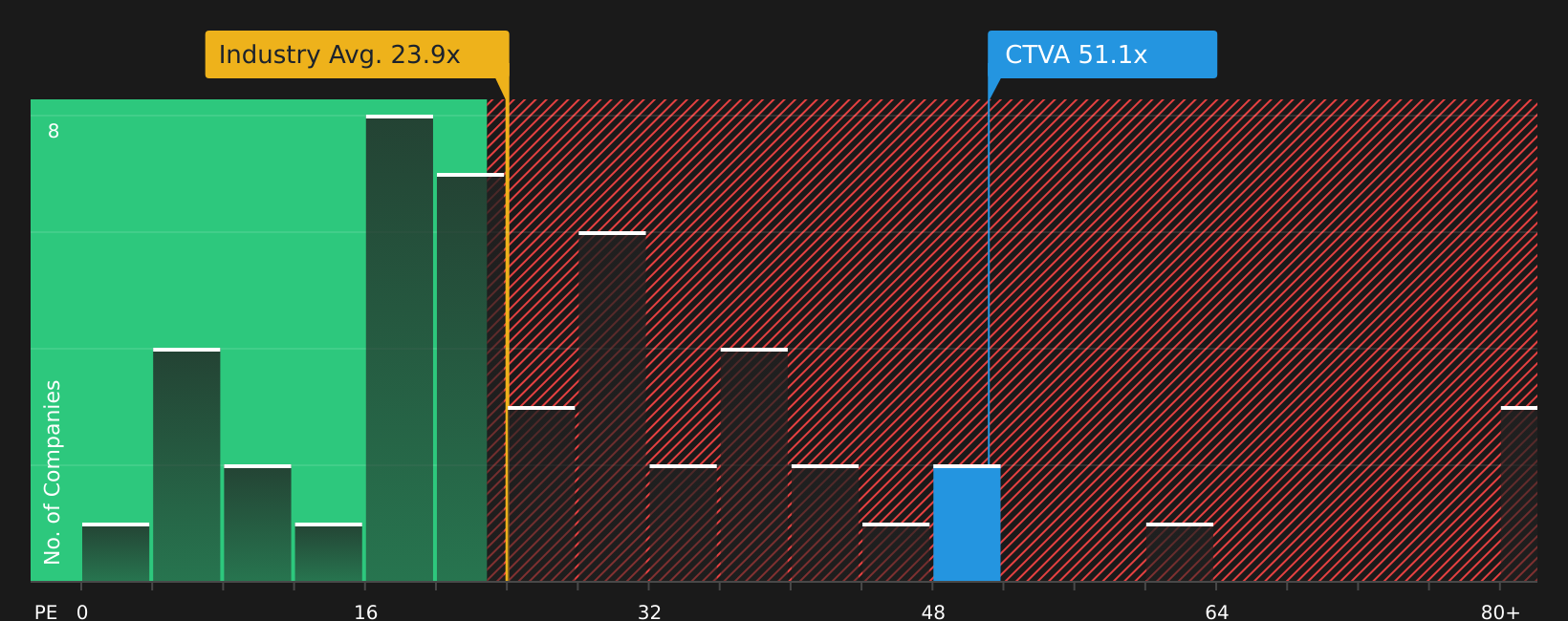
Corteva currently trades on a P/E of about 43.5x. That sits above the Chemicals industry average of around 26.2x and also above the peer group average of roughly 19.3x. In other words, the market is pricing Corteva at a premium to both its sector and similar companies.
Simply Wall St’s “Fair Ratio” for Corteva is 27.4x. This proprietary metric aims to capture what a reasonable P/E might look like after considering factors such as earnings growth, profit margins, risk profile, industry and market cap, rather than relying only on broad peer or industry comparisons.
Because the current P/E of 43.5x is higher than the Fair Ratio of 27.4x, this approach points to the shares looking expensive on earnings at today’s price.
Result: OVERVALUED
P/E ratios tell one story, but what if the real opportunity lies elsewhere? Start investing in legacies, not executives. Discover our 20 top founder-led companies.
Upgrade Your Decision Making: Choose your Corteva Narrative
Earlier the article mentioned that there is an even better way to understand valuation. This is where Narratives come in, giving you a simple story that links your view of Corteva’s business to a set of forecasts and a fair value, all within an easy tool on Simply Wall St’s Community page that millions of investors already use.
A Narrative is your own clear storyline for a company. You spell out what you think will happen to revenue, earnings and margins, then tie those assumptions to a fair value you can compare directly with today’s share price to help decide whether the stock looks attractive or fully priced to you.
What makes Narratives especially useful is that they do not stay static. They update as new information such as earnings releases, analyst revisions or company news is added to the platform, so your story and its fair value stay linked to the latest data without needing to rebuild a spreadsheet each time.
For Corteva, one investor might build a Narrative close to the more optimistic end of analyst views, leaning toward the higher US$92 price target and focusing on margin expansion and new product opportunities. Another might lean toward the US$68 target and focus more on crop protection risks and regulatory pressures. The platform then shows how each story maps into a different fair value so you can see where your own view sits in that range.
Do you think there's more to the story for Corteva? Head over to our Community to see what others are saying!

This article by Simply Wall St is general in nature. We provide commentary based on historical data and analyst forecasts only using an unbiased methodology and our articles are not intended to be financial advice. It does not constitute a recommendation to buy or sell any stock, and does not take account of your objectives, or your financial situation. We aim to bring you long-term focused analysis driven by fundamental data. Note that our analysis may not factor in the latest price-sensitive company announcements or qualitative material. Simply Wall St has no position in any stocks mentioned.
Have feedback on this article? Concerned about the content? Get in touch with us directly. Alternatively, email editorial-team@simplywallst.com